Understanding Chainlink Price Feeds
Learn how Chainlink Price Feeds work, why smart contracts need secure oracles, and how to integrate them in Solidity

Smart Contract & Oracle Problem overview
A smart contract is a self-executing digital agreement with terms written directly into code. They are very powerful on their own, but they have one major limitation, and that is they cannot access real-world data.
A smart contract resides within a blockchain and can access only on-chain data, but the most informative information is stored off-chain. It has no idea what is going on outside, what the price of Ethereum is, what the price of Bitcoin is, etc. This is the fundamental problem of blockchain known as the Oracle Problem.
To solve this problem, Chainlink comes into the spotlight. It creates a bridge between the off-chain and on-chain worlds. Now, smart contracts can make decisions on their own, evaluating real-world data. They are now not just dependent on their state variables.
In this blog, you will learn:
• What an oracle is
• What Chainlink is
• What Chainlink Price Feeds are
• When to use them
• How to implement them
What is an Oracle?
An oracle is a system that delivers real-world data to a smart contract. Blockchain cannot access external information on its own; It is a closed system for security purposes. So, if a blockchain needs information like:
price of Ethereum
price of Bitcoin
random numbers
API responses
match results
stock market data
It must use an Oracle.
What is Chainlink?
There are centralised oracle system in the system. But centralised oracle systems have trust issues; they can be manipulated, they can fail. That is why we use decentralised oracle network.
Chainlink is one of the world’s leading decentralised oracle network. The top DeFi protocols(Aave, Uniswap, Compound, etc) heavily rely on Chainlink. It solves the oracle problem by using multiple independent node operators, aggregating data from many sources, and preventing manipulation. Relying on Chainlink means we are not relying on a single API, we are relying on an entire network.
Smart contracts are powerful, but without oracles, they are blind.
Chainlink gives blockchains the ability to see the real world.
What are Chainlink Price Feeds?
Chainlink Price Feeds are ready-to-use decentralised data feeds. It proveides real-time crypto prices. Examples:
ETH/USD PriceFeed
BTC/USD PriceFeed
LINK/USD PriceFeed
and each Price Feed has:
a unique contract address
a fixed number of decimals
an update frequency
When to use Chainlink Price Feeds?
One should use Chainlink PriceFeeds when they need trusted price data, for example:
minimum deposit based on USD
currency conversion(ETH to USD)
dynamic NFT pricing
liquidation logic in lending DApps
How to use Chainlink Price Feeds?
Chainlink Data Feeds Official Documentation
Import the Chainlink Interface
import {AggregatorV3Interface} from "@chainlink/contracts/src/v0.8/shared/interfaces/AggregatorV3Interface.sol";
Set the price feed with the correct address
get Chainlink Price Feed contract address here
Example(ETH/USD):
AggregatorV3Interface internal dataFeed;

constructor() {
    dataFeed = AggregatorV3Interface(0x5f4eC3Df9cbd43714FE2740f5E3616155c5b8419);
    // //AggregatorV3Interface(Paste the Chainlink Price Feed contract address here)
  }
Use latestRounddata() to read price
function getChainlinkDataFeedLatestAnswer() public view returns (uint256) {
    // prettier-ignore
    (
      /* uint80 roundId */, int256 answer, /*uint256 startedAt*/, /*uint256 updatedAt*/,
      /*uint80 answeredInRound*/
    ) = dataFeed.latestRoundData();
    uint256 ethPrice = uint256(dataFeed * 1e10);/* converting it to uint and scaling decimals properly*/
    return ethPrice;
  }
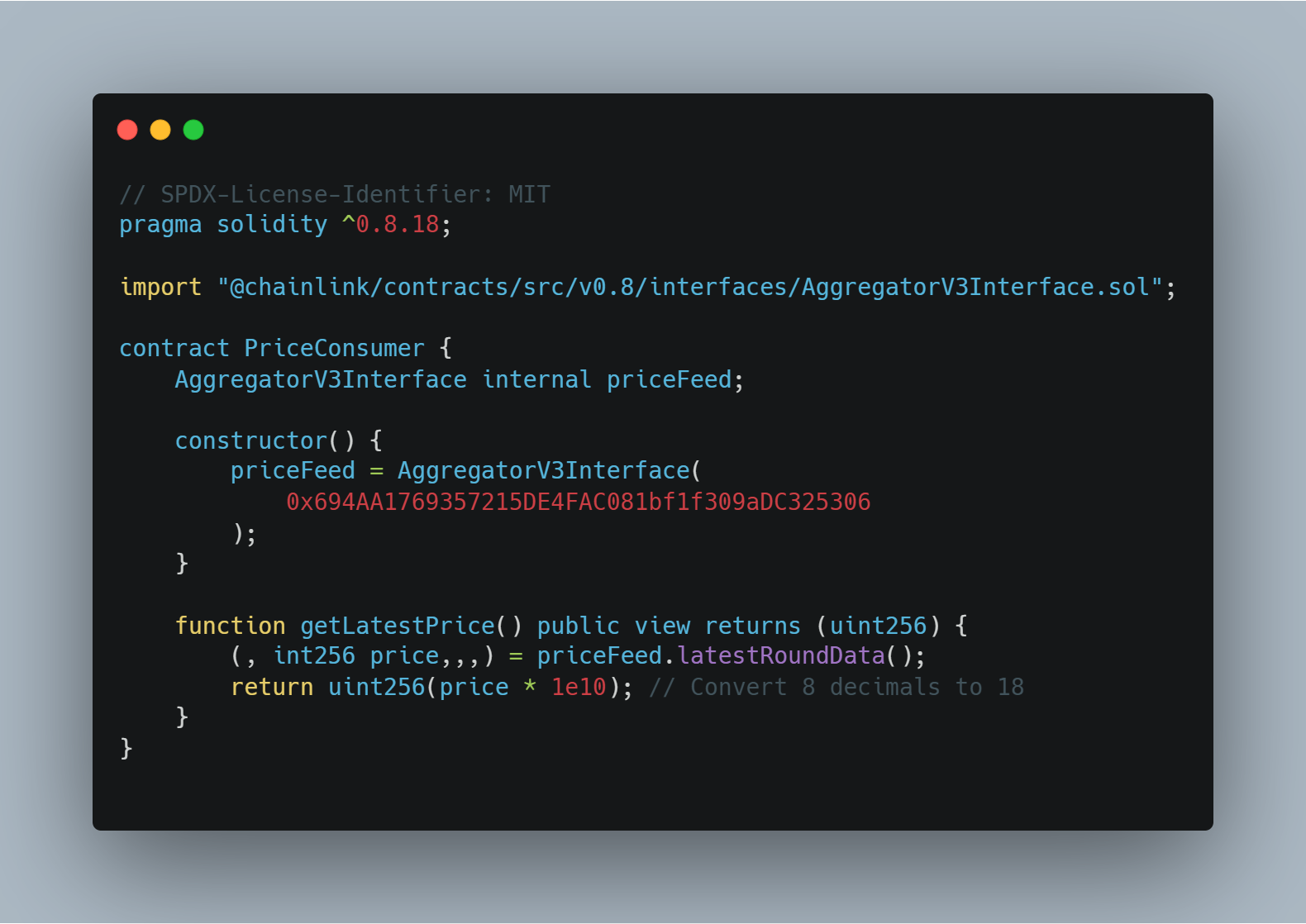
Full smart contract example
Conslusion
Chainlink Price Feeds solve one of the biggest problems in smart contracts, getting reliable, tamper-proof real-world data on-chain. Instead of building your own oracle system or trusting centralised APIs, you can plug directly into decentralised, highly secure price feeds that power billions of dollars across DeFi.
By understanding how to import the AggregatorV3Interface, call latestRoundData(), and convert prices to 18 decimals, you now have the foundation to build safer and more accurate Web3 applications.
Whether you’re creating a DeFi protocol, a funding contract, or just experimenting with Solidity, Chainlink Price Feeds give you a professional-grade data layer you can rely on.
So, keep exploring, keep growing, keep building and keep levelling up your web3 skills.
